See clearly at every distance — distance, intermediate, and near — in one seamless lens.
Progressive lenses are multifocal lenses that correct your vision at every distance — far, intermediate, and near — without the visible lines found on bifocals or trifocals. The power changes gradually from the top of the lens to the bottom, giving you a smooth, natural transition as your eyes move from looking at the road ahead, to your car dashboard, to your phone.
Most people start needing progressive lenses around age 40, when a condition called presbyopia makes it harder to focus on close-up objects. Presbyopia happens to everyone — it is a normal part of aging, not a disease. If you find yourself holding your phone at arm's length or removing your glasses to read, progressive lenses are likely the solution.
At Fantastic Glasses we carry three tiers of progressive lenses — Standard, Premium, and Elite — so you can choose the design that fits your lifestyle, visual demands, and budget.
The right tier depends on your prescription, your frame, and how you use your eyes every day
A side-by-side look at what each tier delivers
| Feature | Standard | Premium | Elite |
|---|---|---|---|
| Field of Vision | Functional corridor with moderate width | Wider corridor — more room at intermediate and near | Widest corridor — clear vision nearly edge-to-edge |
| Peripheral Clarity | Noticeable soft focus at the edges | Reduced soft focus — smoother periphery | Minimal soft focus — closest to natural vision |
| Frame Compatibility | Medium-to-large frames recommended | Works with a wider range including smaller styles | Excellent in any frame size or shape |
| Adaptation Period | 1–2 weeks | Under 1 week | 1–2 days (some same-day) |
| Technology | Conventional progressive geometry | Enhanced multi-design optics | Freeform digital surfacing, point-by-point customization |
| Best For | First-time wearers, budget-focused | Upgraders, active lifestyles | High Rx, demanding tasks, maximum comfort |
| Included in 3-for-1? | Yes | Yes | Yes |
Not sure which tier is right for you? Our opticians will recommend the best option based on your prescription and how you use your eyes. Book a consultation.
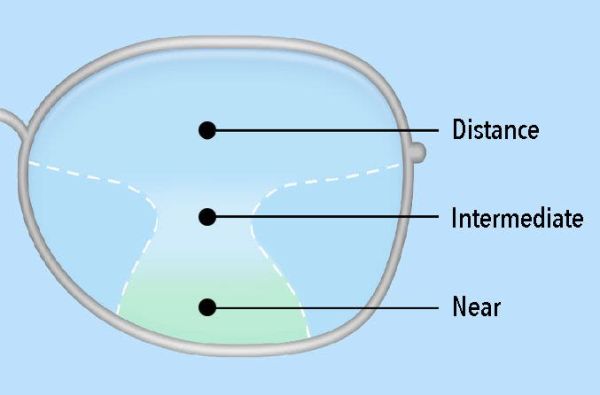
A progressive lens is divided into three seamless zones. There are no lines or visible boundaries — the power changes gradually from one zone to the next.
The progressive corridor is the clear channel running vertically through the centre of the lens. This is where your vision is sharpest. The width of this corridor is the biggest difference between Standard, Premium, and Elite tiers — a wider corridor means more usable clear vision at every distance.
To the left and right of the corridor, there are areas of soft focus (sometimes called peripheral blur). This is an optical trade-off inherent to all progressive lenses — no design can eliminate it entirely, but higher-tier lenses push it further toward the edges where it is less noticeable.
Head movement matters. With progressive lenses, you learn to point your nose at what you want to see rather than just moving your eyes. This keeps the object in the clear corridor. It becomes second nature within days for most wearers.
Most people adapt quickly — here is how to make the transition as smooth as possible
Your brain needs consistent input to rewire itself. Switching back and forth between old and new glasses slows down adaptation. Commit to wearing your progressive lenses all day, every day.
Point your nose at what you want to see. This keeps the object in the clear corridor of the lens. Looking to the side with your eyes alone moves your gaze into the soft-focus periphery.
When looking down at stairs, tilt your head slightly forward so you are looking through the distance zone rather than the near zone. This prevents the steps from appearing distorted.
Position your computer monitor so you can view it through the intermediate zone (middle of the lens) without tilting your head uncomfortably. A monitor arm or laptop stand helps.
Standard progressive lenses typically take up to 2 weeks. Premium and Elite designs adapt faster. If you still feel uncomfortable after 2 weeks, come back — we will check your fit and prescription at no charge.
Progressive lenses are position-sensitive. If your frame sits even 2 mm too high or too low, the zones will not align with your eyes. We adjust every pair for free, and you should come back any time they feel off.
Looking for more detailed guidance? Visit our how-to guides for step-by-step progressive lens tips.
Progressive lenses are more sensitive to prescription accuracy than single-vision lenses. Even a small error in your sphere, cylinder, or axis values can make the soft-focus areas feel larger and adaptation harder. That is why getting the right prescription is the most important step.
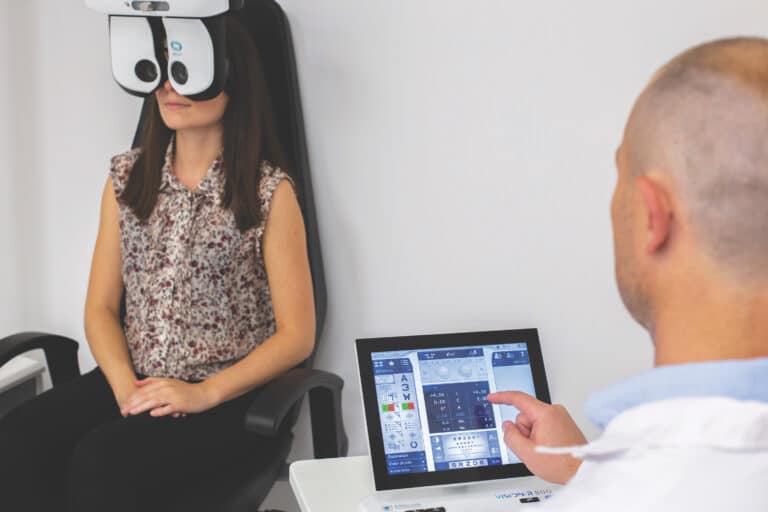
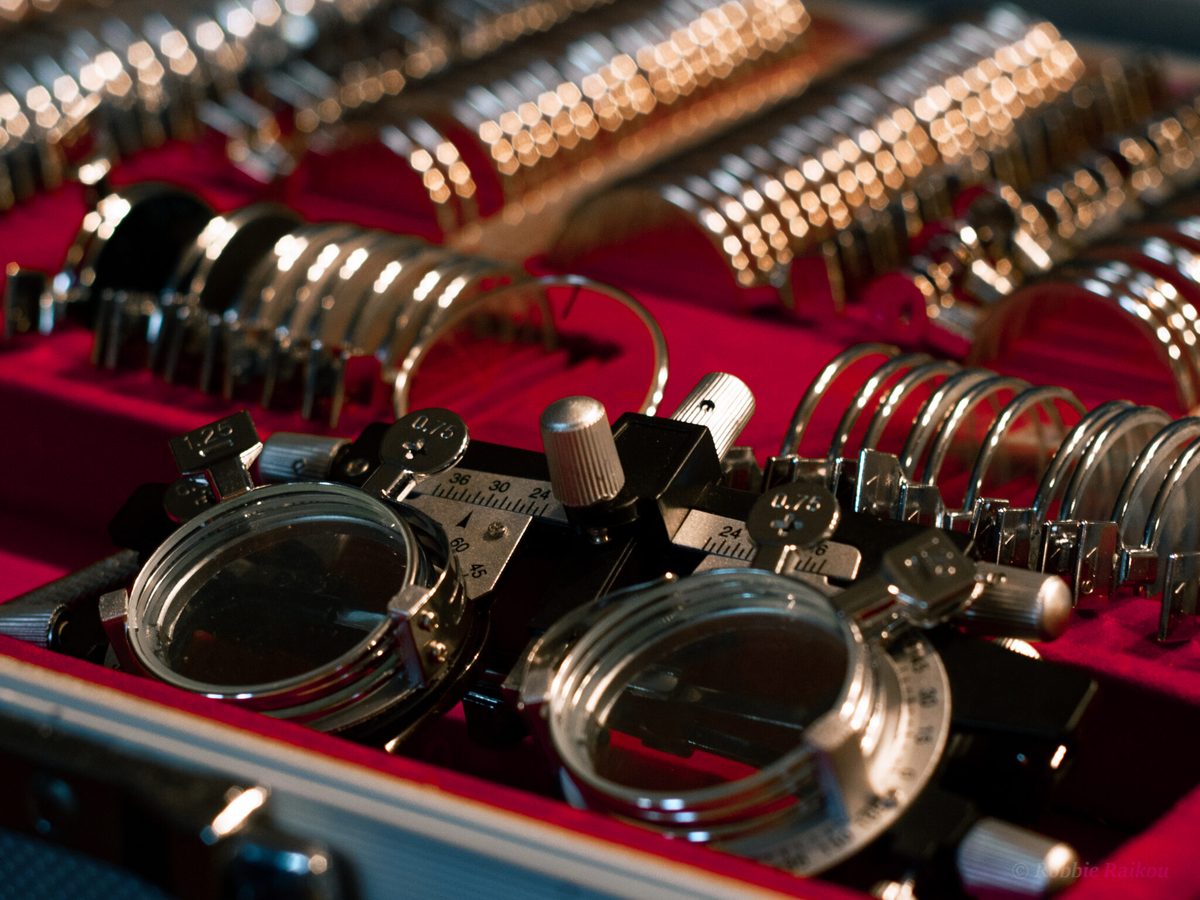
At Fantastic Glasses, every eye test is performed with the Essilor Vision-R 800 — the most advanced digital phoropter in the world. It measures in 0.01 diopter steps (five times finer than a traditional phoropter), which means your progressive lenses are built on the most precise prescription possible.
Your eye test is completely free with any eyewear purchase. No referral needed, no hidden fees.
Progressive lenses are not limited to clear eyeglasses. You can have your progressive prescription made into:
All of these options can be combined with any tier — Standard, Premium, or Elite — and all are eligible for our 3-for-1 deal.
Progressive lenses are multifocal lenses with no visible lines. They provide a smooth, continuous transition between three zones of vision — distance at the top, intermediate in the middle, and near at the bottom — so you can see clearly at every distance without switching glasses. They are the modern replacement for bifocals and trifocals.
It depends on the lens tier. Standard progressive lenses typically take 1 to 2 weeks. Premium progressives usually take under a week thanks to wider viewing corridors. Elite progressive lenses, made with freeform digital surfacing, often feel natural within 1 to 2 days. The key is to wear them full-time from day one and move your head (not just your eyes) to look at things.
Standard progressive lenses provide clear distance, intermediate, and near vision but have narrower viewing corridors with more soft focus at the edges. Premium progressive lenses use improved optical designs to deliver a wider corridor of clear vision, less peripheral distortion, and better compatibility with a wider range of frame shapes. Most people who upgrade from Standard to Premium notice a significant improvement in comfort and usability.
Elite progressive lenses are worth it if you want the widest possible field of clear vision with minimal soft focus areas. They use freeform digital surfacing to customize the lens point-by-point to your exact prescription, frame measurements, and wearing position. People with high prescriptions, complex visual demands (like musicians or architects), or previous difficulty adapting to progressives benefit the most from Elite lenses.
Yes. Progressive lenses can be made as prescription sunglasses with polarized, tinted, gradient, or photochromic (Transitions) options. At Fantastic Glasses, progressive sunglasses are included in our 3-for-1 deal — so you can have everyday glasses, computer glasses, and progressive sunglasses all from one prescription.
General-purpose progressive lenses work at a computer, but the intermediate zone is relatively narrow — especially in Standard designs. If you spend long hours at a screen, a dedicated pair of computer progressive lenses (also called office or occupational lenses) gives you a much wider intermediate and near zone. Our 3-for-1 deal lets you add a computer pair alongside your everyday progressives at no extra cost.
At Fantastic Glasses, three pairs of progressive glasses start at $349. The price varies depending on the tier — Standard, Premium, or Elite — and any add-ons like anti-reflective coatings, blue light filtering, or Transitions. We offer direct insurance billing so you can use your benefits with no paperwork or out-of-pocket hassle.
For most people, yes. Progressive lenses have no visible line (so they look like regular glasses), they include an intermediate zone for computers and dashboards (which bifocals lack), and they transition smoothly between zones instead of creating an abrupt image jump. The vast majority of people who switch from bifocals to progressive lenses prefer them and do not go back. However, some patients with very specific needs may still prefer bifocals — our opticians can advise.
Yes. Your progressive lens prescription contains both your distance power and your near (Add) power. An optician can use it to make dedicated single-vision reading glasses if you want a pair just for close work. At Fantastic Glasses, you can include a reading pair in your 3-for-1 deal alongside your progressives — distance, computer, and reading, all from one prescription.
Yes. Three pairs of progressive glasses start at $349 with our 3-for-1 deal. You can mix and match — for example, everyday progressives, computer progressives, and progressive sunglasses. A free eye test with the Essilor R800 is included with every purchase.
Fantastic Glasses is located at Unit 401, 235 Milligan Dr, Okotoks, AB — serving patients from Calgary, High River, Black Diamond, Turner Valley, De Winton, and surrounding communities in southern Alberta.
We carry all three tiers of progressive lenses in-store, and our opticians take the precise measurements needed — pupillary distance, fitting height, pantoscopic tilt, and frame wrap angle — to ensure your lenses are built exactly right. Walk-ins are welcome, but booking ahead guarantees your time slot.
Book your free eye test and let our opticians match you with the perfect progressive lenses — Standard, Premium, or Elite. Call (587) 997-3937 or book online.