Bifocal Lenses

Two prescription zones in one pair — a proven, reliable solution for distance and reading.

What Are Bifocal Lenses?

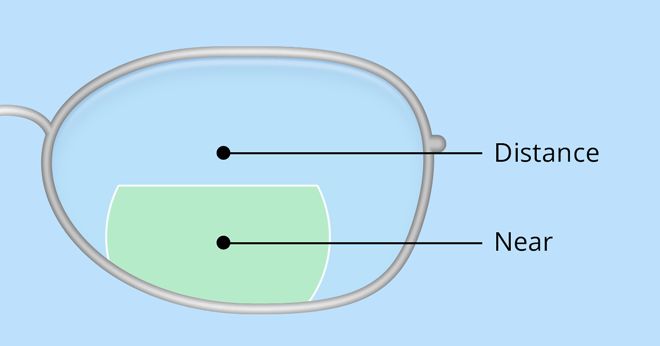
Bifocal lenses feature two distinct prescription zones separated by a visible line. The upper portion corrects your distance vision — driving, watching TV, walking, and everyday tasks. The lower portion corrects your near vision — reading, texting, menus, and close-up work.

Bifocals are one of the oldest and most proven multifocal designs in optics, first invented by Benjamin Franklin in the 1780s. They remain widely used today because they are simple, effective, and affordable. The clear boundary between zones makes it easy to know exactly where to look — straight ahead for distance, down for reading — with no guesswork involved.

Most people are prescribed bifocals after age 40, when a condition called presbyopia makes it harder to focus on close-up objects. Presbyopia happens to everyone — it is a natural part of aging. If you catch yourself holding your phone at arm's length or removing your glasses to read fine print, bifocals (or progressive lenses) are the solution.
Bifocal lenses — two-zone multifocal lenses at Fantastic Glasses

Bifocal vs Progressive Lenses

The biggest question patients ask is whether to choose bifocals or progressives. Here is an honest comparison:

  • Visible line — bifocals have a visible line between zones. Progressive lenses have no line and look like regular glasses.
  • Intermediate zone — bifocals only cover distance and near. Progressive lenses add an intermediate zone for computer screens, dashboards, and cooking.
  • Adaptation — bifocals are generally easier to adapt to because the zones are clearly defined. Progressive lenses require learning to move your head to find the right zone.
  • Image jump — bifocals create an abrupt shift when your eyes cross the line. Progressives transition smoothly.
  • Cost — bifocals are typically less expensive than progressive lenses, making them the more budget-friendly multifocal option.
  • Aesthetics — progressive lenses are cosmetically preferred because nobody can tell you are wearing multifocals.

Both are included in our 3-for-1 deal. Our opticians will help you decide which makes the most sense for your eyes, your lifestyle, and your budget.

Bifocal vs progressive lenses — compare multifocal options

Who Should Choose Bifocal Lenses?

Bifocals are the right choice in several situations

  • You prefer a clear boundary between zones — some people find the defined line easier to use than the gradual transition of progressives
  • You tried progressives and could not adapt — a small percentage of people find progressive lenses uncomfortable. Bifocals are a proven alternative.
  • You primarily need distance and reading — if you do not spend much time at computer distance, the lack of an intermediate zone is not a problem
  • Budget is a priority — bifocals are more affordable than progressive lenses while still giving you two prescriptions in one pair
  • Certain occupations — some trades and manual labour roles prefer bifocals for the wide, undistorted distance zone overhead and a clear reading zone for close work below

Coatings & Add-Ons

Bifocal lenses can be paired with all the same upgrades as single vision or progressive lenses:

  • Anti-reflective coating — reduces glare and makes lenses nearly invisible
  • Blue light filtering — reduces digital eye strain from screens
  • Transitions (photochromic) — darkens outdoors, clears indoors
  • Polarized tint — for bifocal sunglasses
  • High-index materials — thinner and lighter lenses for stronger prescriptions

3 Pairs of Bifocal Glasses from $449

Three frames with bifocal lenses — everyday, sunglasses, or reading. Free eye test included.

Learn About the 3-for-1 Deal Book Appointment

A Precise Prescription Makes All the Difference

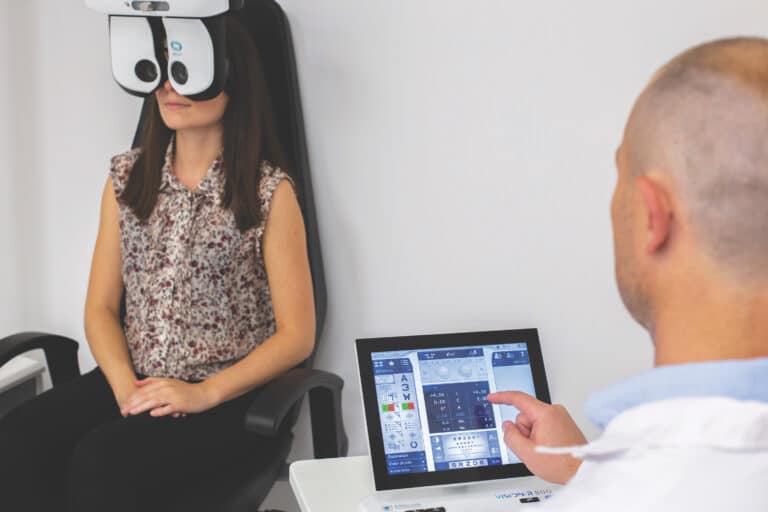
Bifocal lenses need accurate distance and near (Add) power measurements. Even a small error can make the reading zone feel wrong or cause headaches. At Fantastic Glasses, every eye test is performed with the Essilor Vision-R 800 — the most advanced digital phoropter available. It measures in 0.01 diopter steps, five times finer than a traditional phoropter.

After your test, our opticians measure your segment height — the exact position of the bifocal line relative to your pupil in your chosen frame. Getting this measurement right ensures the reading zone sits exactly where you need it, not too high and not too low.

Your eye test is completely free with any eyewear purchase. Eye tests are also free for adults 65+.

Learn About Our Free Eye Test
Essilor R800 eye test — precision prescription for bifocal lenses

Frequently Asked Questions About Bifocal Lenses

What are bifocal lenses?

Bifocal lenses have two distinct prescription zones separated by a visible line. The upper portion corrects distance vision and the lower portion corrects near vision. They are one of the oldest and most proven multifocal lens designs, widely used for over 200 years.

What is the difference between bifocal and progressive lenses?

Bifocals have two zones (distance and near) with a visible line and no intermediate zone. Progressive lenses have three zones (distance, intermediate, and near) with no visible line. Progressives cover more distances and look like regular glasses, but bifocals are simpler to adapt to and more cost-effective.

Who should wear bifocal lenses?

Bifocals are typically prescribed for people over 40 with presbyopia who need both distance and near correction. They are a good choice for people who prefer a clear boundary between zones, those who have had difficulty adapting to progressive lenses, and patients looking for a budget-friendly multifocal option.

How long does it take to adapt to bifocals?

Most people adapt to bifocal lenses within a few days to one week. The visible line makes it easy to know which zone you are looking through. The main adjustment is learning to lower your gaze for reading and being aware of the image jump when your eyes cross the line.

Can bifocal lenses be made as sunglasses?

Yes. Bifocal lenses can be tinted, polarized, or made with Transitions (photochromic) technology. At Fantastic Glasses, bifocal sunglasses can be included in our 3-for-1 deal alongside your everyday bifocals.

Do bifocal lenses work for computer use?

Bifocals are not ideal for extended computer use because they lack an intermediate zone. Your computer screen is typically at arm's length, which falls between the distance and near zones. For serious screen time, dedicated computer lenses or progressive lenses with a wider intermediate zone are a better choice.

Are bifocals included in your 3-for-1 deal?

Yes. Three pairs of bifocal glasses are included in our 3-for-1 deal starting at $449. You can mix and match — everyday bifocals, bifocal sunglasses, and a dedicated reading pair. A free eye test with the Essilor R800 is included with every purchase.

Bifocal Lenses Near You

Fantastic Glasses is located at Unit 401, 235 Milligan Dr, Okotoks, AB — serving patients from Calgary, High River, Black Diamond, Turner Valley, De Winton, and surrounding communities in southern Alberta. South Calgary communities like Shawnessy, Cranston, and McKenzie Towne are just a 20-minute drive.

Our opticians will measure your segment height precisely in your chosen frame so the reading zone sits exactly where you need it. Walk-ins are welcome, but booking ahead guarantees your time slot.

Book Appointment Get Directions
Fantastic Glasses storefront — bifocal lenses in Okotoks near Calgary

Distance and Reading — Sorted

Book your free eye test and let our opticians fit you with the right bifocal lenses. Not sure if bifocals or progressives are right for you? We will help you decide. Call (587) 997-3937 or book online.

★★★★★ 143 Five-Star Google Reviews
Okotoks' highest-rated eyewear store